
How to Measure and Grow Your Brand's Visibility in AI Search
People are settling debates, comparing products, and choosing providers by asking ChatGPT, Claude, Gemini, and Perplexity; not just Google. Traffic from AI tools is exploding, yet none of these platforms share exact data on how often your brand appears in their answers. This guide explains what you can measure (including Google’s brand-new Generative AI report in Search Console), how to set a baseline for your brand’s AI visibility, and the concrete content moves that actually get you cited in AI answers – based on real work we do with clients every week.
The search pattern has changed
Not long ago, two people disagreeing over dinner would say: “Let’s google it.”
Today, that same conversation ends with “Let’s ask ChatGPT”, Claude, or Gemini. The answer arrives as a single, confident paragraph. And here’s the part that should matter to every marketer: either your brand is in that paragraph, or it isn’t.
This isn’t a niche behavior anymore. Google reports that AI Overviews now reaches over 2.5 billion monthly users, and AI Mode has passed one billion (Google, 2026). ChatGPT alone handles billions of prompts every week. When people research insurance, savings, software, sneakers, or plumbers, an AI model increasingly writes the shortlist.
We see the effect directly in our clients’ analytics. One of our enterprise clients saw traffic from AI tools grow by 1,000% from 2024 to 2025 and it has kept climbing since, with ChatGPT driving the large majority of AI referral sessions, followed by Copilot, Perplexity, Gemini, and Claude.
The visitors arriving from AI answers are also different: they’ve already been “pre-sold” by the model. In our client data, sessions from AI tools consistently show strong engagement times and conversion behavior. Fewer clicks, better clicks.

The Measurement Problem: Nobody Shares the Real Numbers
Here’s the uncomfortable truth about AI search visibility: no AI platform tells you how often your brand appears in its answers.
ChatGPT, Claude, Gemini, Perplexity – none of them offer a dashboard showing your mentions, your share of answers, or which questions triggered them. Unlike classic SEO, where rankings are observable, AI answers are generated fresh, vary between users, and leave almost no trace.
So what can you actually use?
Third-party visibility tools. Platforms like Semrush and Ahrefs (and dedicated AI-visibility trackers) run large sets of prompts against the AI models and record which brands get mentioned and cited. This is genuinely useful for benchmarking against competitors – but be honest with yourself and your stakeholders about what it is: an indication built on simulated prompts, not real user data.
Your own analytics. Referral traffic from chatgpt.com, perplexity.ai, gemini.google.com, copilot.com, and claude.ai is real, first-party data. It only captures the users who click through – not everyone who read your brand’s name in an answer but it’s the truest trend line you have.
And now, finally: Google itself. In June 2026, Google launched a dedicated Generative AI performance report in Search Console – the first-ever first-party data on AI visibility. It shows how often your URLs appear inside AI Overviews, AI Mode, and Discover’s AI features, broken down by page, country, device, and date (Google Search Central, 2026). It’s a genuine milestone: after two years of guessing, you can finally see whether Google’s AI features are surfacing your content.
Just know its limits. The report currently shows impressions only – no clicks, no click-through rate, and no queries. You can see which pages appear in AI answers, but not which questions put them there, and nothing about competitors. It’s rolling out gradually, so it may not be live for your site yet. For prompt-level and competitive insight, third-party tracking is still necessary. But as a baseline metric straight from the source? Take it, screenshot it on day one, and track it monthly – there’s no historical backfill.
Strengthening Retention Through Early Signals
Client retention is often shaped by small signals that appear long before a contract ends. Fyr highlights these signals so your team can act early. Alerts for declining engagement, reduced activity, or changing performance patterns give agencies an opportunity to reach out and adjust the strategy. Consistent transparency through white-label dashboards and clear reporting reinforces trust and makes clients feel supported.
Start Here: Set a Zero Measurement Point
You can’t manage what you don’t measure – and in AI search, you can’t measure everything. The answer isn’t to give up on measurement; it’s to define a baseline with the data that exists and track movement against it.
This is exactly how we start with clients. A solid AI-visibility baseline includes:
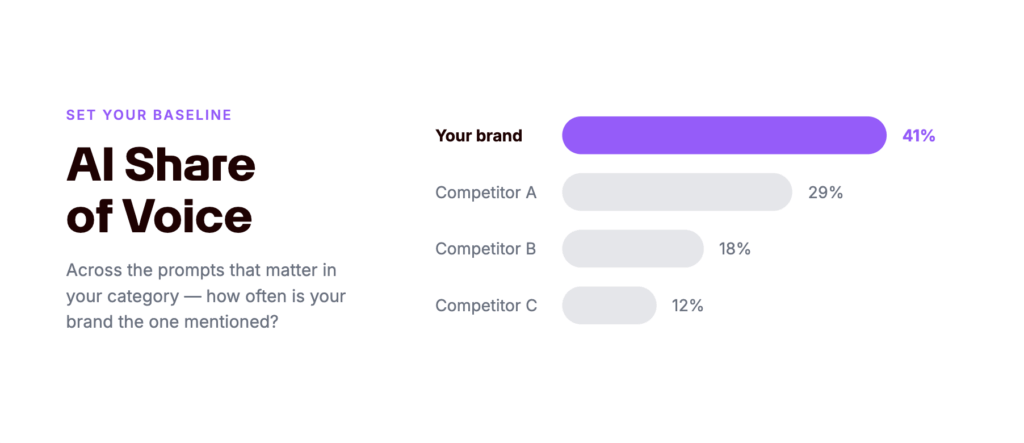
- AI Share of Voice – across a fixed set of prompts that matter in your category, how often is your brand mentioned compared to competitors?
- Mentions – the number of times your brand is named in AI answers across your prompt set.
- Citations – how often AI answers link to or cite pages from your own domain.
- AI referral traffic – sessions from each AI platform in your analytics, tracked monthly and year over year.
- Google’s AI impressions – from the new Search Console report, once it’s live for your site.
Date-stamp the baseline. From that day forward, every content change, every new page, every structural improvement can be evaluated against something concrete. When we did this exercise for a client recently, the baseline immediately exposed the strategy: strong visibility in one product category, zero mentions in another core category the AI models simply didn’t associate with the brand. That’s not a vague ambition anymore – that’s a to-do list.
What Actually Gets You Into AI Answers
Once you can measure, the question becomes: what moves the numbers? From our hands-on work across categories, these are the patterns that keep proving themselves.
Specific beats broad – every time
Classic SEO rewarded big, comprehensive pages that covered everything about a topic. AI search flips this. Prompts are longer and more specific than Google searches ever were – people ask the actual question, details included. The models then retrieve the content that answers that exact question best.
We’ve watched challenger brands win AI visibility with a single dedicated page answering one narrow question – for example, a Nordic bank that built a standalone page about insuring one specific popular EV model – while larger competitors sat invisible behind broad, generic category pages. One focused page that fully owns one question outperforms a mega-page that half-answers twenty.
Answer first, and make every section stand alone
Language models retrieve chunks of pages, not whole pages – and research shows they systematically favor content at the beginning and end of what they retrieve, often ignoring the middle. The practical consequence: put the direct answer in the first lines of every section, and write each section so it makes sense in isolation. Q&A-formatted content (a real question as the heading, a clear answer immediately below) is tailor-made for how retrieval works.
Third-party voices weigh more than your own
AI models are trained to seek consensus across independent sources. Your own website saying you’re great is one signal; review platforms, comparison sites, industry press, and satisfaction surveys saying it are far stronger. In our competitive analyses, we consistently see brands with high customer-satisfaction scores on comparison platforms punch far above their market share in AI answers. Your reputation footprint outside your own domain is now a visibility asset.
Get your entity foundations right
AI systems need to know, with confidence, what your brand is. Wikipedia and Wikidata play an outsized role here: a complete, accurate entity profile – what you offer, who you are, linked to your domain with schema markup – raises the model’s confidence, and confident models cite. It’s unglamorous work that takes days, not months, and it underpins everything else.
Different engines, different rules
Perplexity heavily favors freshness and pulls from community sources like Reddit and YouTube. ChatGPT leans toward established publisher authority. Google’s AI Overviews visibly reward brands with years of solid SEO behind them – we see clients perform notably better in AI Overviews than in standalone chatbots for exactly this reason. Two takeaways: your existing SEO investment is not wasted (it’s your head start in Google’s AI surfaces), and a strategy tuned for one engine won’t automatically work in another.
Quick Wins for Your First Month
You don’t need a year-long program to see movement. Start here:
- Add FAQ sections to your three most important pages – real questions in natural language, direct answers underneath. Effects often show up in prompt testing within weeks.
- Create or fix your Wikidata entry and add matching schema markup. One or two days of work, foundational payoff.
- Start a weekly prompt log. Run 10–15 real customer questions through ChatGPT, Gemini, and Perplexity every week. Note whether you’re mentioned and what’s said. It costs nothing and gives you trend data from day one.
- Refresh your best existing content with updated dates, current numbers, and one new section – freshness-driven engines notice.
- Publish one comparison article on a question where you genuinely compete well. Neutral, structured comparisons are exactly what models reach for when users ask “X or Y?”
💡 Pro tip: Fyr’s dashboards track AI referral traffic from ChatGPT, Copilot, Perplexity, Gemini, and Claude automatically – alongside your other marketing data – so your AI-visibility baseline lives in the same place as the rest of your reporting, updated without lifting a finger.
Common Mistakes to Avoid
- Treating AI visibility as a separate silo instead of building on your existing SEO foundation.
- Reporting third-party visibility scores as if they were exact figures – set honest expectations with stakeholders.
- Optimizing for one AI engine and assuming the rest will follow.
- Measuring once and never again. AI answers change constantly; only continuous tracking reveals whether your work lands.
Conclusion: Be the Answer, Not the Afterthought
The shift from “let’s google it” to “let’s ask ChatGPT” is the biggest change in how people find brands since search itself. The winners won’t be the ones who wait for perfect data – it doesn’t exist yet. They’ll be the ones who set a baseline now, build content the way AI models actually read it, and track their progress month after month.