
TL;DR: Most businesses don’t own their marketing data. They rent it. It’s spread across Google, Meta, LinkedIn and TikTok, each with its own dashboard, its own retention limits and its own version of the truth. Owning your data means your business controls the accounts, the overview and the definitions, and sees every channel side by side in one independent place, so you can prove ROI across every platform instead of letting each one grade its own homework. This guide explains why that matters more than ever, including in AI search where no platform shares any data at all, and how Fyr helps you take control.
Whose data is it anyway?
Here’s a question worth asking in your next marketing meeting: if one of your ad platforms changed its rules tomorrow, how much of your marketing history would you still have?
For most teams, the honest answer is: less than they think. Every campaign, every click and every conversion generates data. But that data is scattered across a handful of ad platforms, each showing it in its own dashboard and measuring it with its own model.
That’s fine, right up until it isn’t. A platform shortens its data retention. A tracking tool is retired. An agency relationship ends and the ad accounts turn out to be in the agency’s name. Suddenly the data you thought was yours is gone, locked or impossible to compare.
Owning your marketing data is how you stop renting your own history.
What does it mean to own your marketing data?
Owning your marketing data means your business has direct control over its multi-channel customer and performance data: who can access it, how it’s measured and where it all comes together. Not each ad network deciding on its own.
That doesn’t mean you have to build everything yourself. In practice, ownership comes down to three things:
- Access. The accounts, properties and pixels are registered to your business, and you decide who gets in. Not your agency, not a former employee.
- Overview. All channels meet in one independent place, where paid, organic, web, social and e-commerce are measured side by side. Not scattered across six platform dashboards.
- Definitions. You decide what a conversion, a lead or a customer is. The same KPI means the same thing across every channel and every report.
Platform dashboards vs. a dashboard in Fyr
Here’s a distinction that matters. Google’s dashboard shows you Google’s results, measured Google’s way. Meta’s shows you Meta’s. Each one is built by a company that also sells you the ads.
There are basically three ways to get the full picture:
The point isn’t to avoid dashboards. It’s to choose one that works for you, not for the ad networks.
Why owning your data matters
Platforms change the rules, and they don’t ask first
Remember Universal Analytics? Google stopped processing new UA data in July 2023 and switched off access to the old data a year later. Teams that hadn’t exported their history lost years of benchmarks overnight. GA4 isn’t built for long memory either: event-level data in the standard version is kept for a maximum of 14 months, and only if someone remembers to change the default of two.
It’s not just Google. When Meta made Advantage+ Creative Enhancements the default, advertisers suddenly ran settings they never chose. When the platform owns the data and the defaults, the platform sets the agenda.
Every platform grades its own homework
Google Ads reports a conversion. Meta reports the same conversion. So does LinkedIn. Add them up and your campaigns sold more than your business did. Each platform measures with its own attribution model, and each one has an interest in looking good.
That’s why you need an independent view: all channels side by side, measured on your definitions, so you can see what actually drove the result.
You can’t prove multi-platform ROI with single-platform data
Marketing leaders are under more pressure than ever to prove what marketing returns, and to decide which channels deserve the budget. And the budget isn’t growing to make it easier. Gartner’s 2026 CMO Spend Survey found marketing budgets flat at 7.8% of company revenue, and 56% of CMOs say they lack the budget to deliver their strategy (Gartner). When every krone has to work harder, guessing isn’t an option.
But look at what most teams have to work with. Google Ads reports one ROAS, Meta another, LinkedIn a third. Each is calculated on its own attribution model and its own idea of a conversion, so the numbers can’t be added up or compared. Ask the platforms which channel gives you the most back per krone, and every one of them answers: me.
Owning your data changes the question from “what does each platform claim?” to “what did our spend actually deliver?” With spend and results from every channel in one place, on the same definitions, you can:
- Compare cost per acquisition and return across channels on equal terms.
- Hold total marketing spend up against real revenue from your web shop or CRM, not just platform-reported conversions.
- Spot the channels that look great in their own dashboard but add little to the bottom line, and move budget to the ones that do.
- Show management or clients a ROI number they can trust, because it doesn’t come from the platforms selling you the ads.
AI is only as smart as the data underneath
Everyone wants AI-driven insights. But AI doesn’t fix messy data, it amplifies it. Poor data quality already costs organizations an average of $12.9 million a year (Gartner). Feed an AI model fragmented, inconsistent data and you get confident answers to the wrong questions. Clean, owned, well-defined data is what gives AI its superpowers.
Your data should outlive your agencies and employees
Agencies change. People change jobs. If your ad accounts and analytics properties are registered to a supplier or a single person, every change becomes a risk. Homemade reporting setups have the same weakness: they often depend on the one person who built them. When the accounts belong to the business and the overview lives in a shared platform the whole team uses, you can switch partners without starting from zero.
How Fyr helps you take control
Fyr is an independent marketing platform. We’re not one of the ad networks, so we have no stake in which channel looks best. Our job is to unite all your marketing data in one place and give you the full picture, on your terms.

With Fyr, you can:
- Connect all your channels in minutes, no coding required. Google Ads, Microsoft Ads, Meta, TikTok, LinkedIn, Snapchat, DV360, Adform, Xandr and more, alongside GA4, Google Search Console and Google BigQuery.
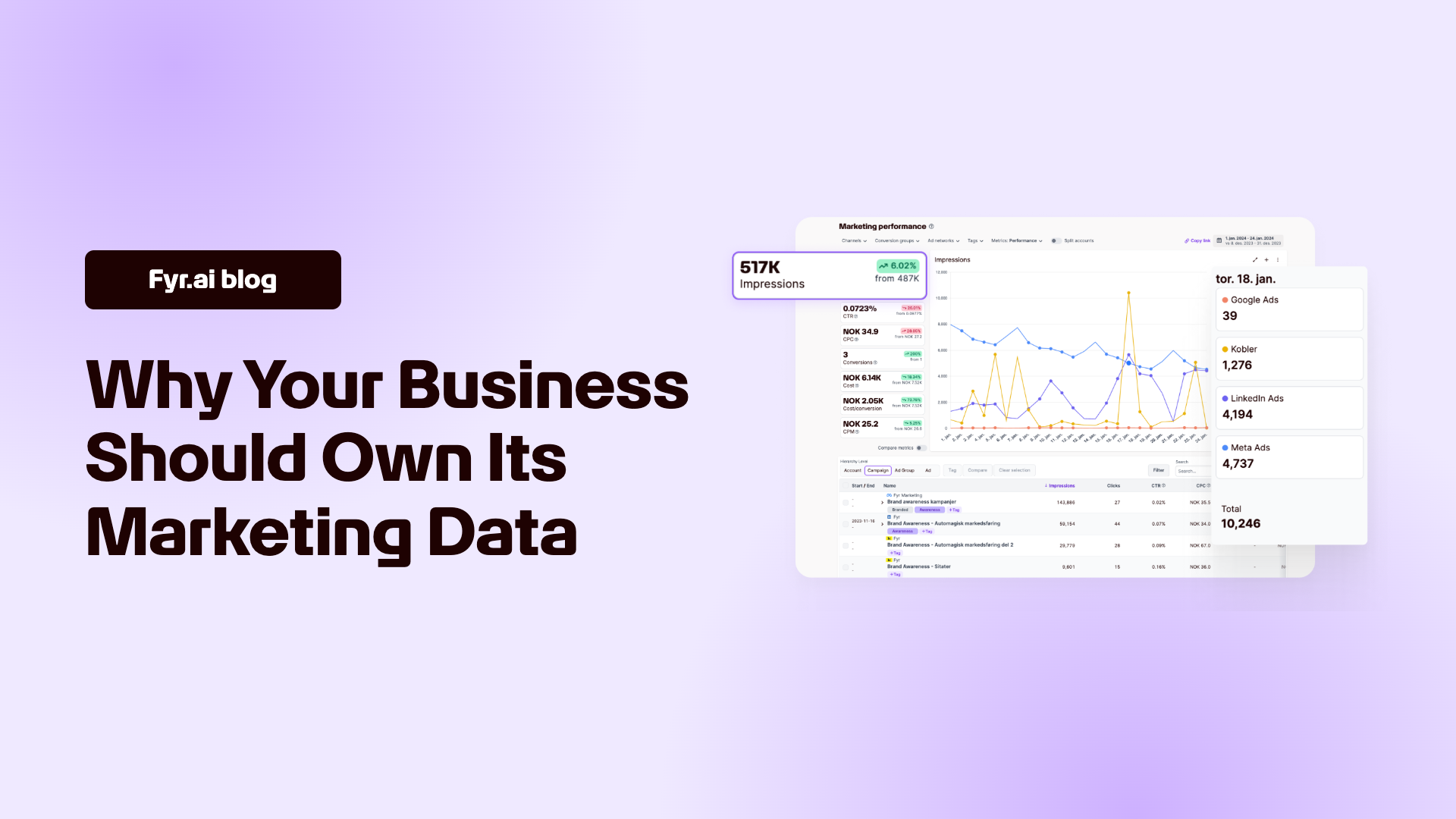
- Work from one source of truth. Ad spend and performance, website, e-commerce and social media in real-time dashboards, built on your own KPIs, so you can show stakeholders a clear return across every platform.
- Keep an eye on your competitors with competitor monitoring, social media tracking and share of search.
- Track your AI visibility in one dashboard. Search Console’s AI impressions, AI referral traffic from ChatGPT, Copilot, Perplexity, Gemini and Claude, and tracking of how often your brand is mentioned and cited in AI answers.
- Let AI do the heavy lifting. The recommendation hub continuously monitors your data and highlights opportunities, so you spend your time on decisions instead of data collection.
- Share it with everyone who needs it. Custom reports and live dashboards with permissions, for your team, your management or your clients.
The effect is measurable. Marketing teams using Fyr spend 54% less time on reporting and see a 32% higher return on marketing investment (Fyr). When the Finnish media agency NØRR3 replaced heavy reporting tools that kept breaking with Fyr as their single source of truth, they cut client reporting time by 30% and internal data requests by 40% (read the case).
Pro tip: Start your AI visibility baseline today, even if you're not ready to act on it yet. AI answers leave no history behind, so every month you wait is a month of data you'll never get back.
Conclusion: Stop renting your own history
Platforms will keep changing their rules. Tracking will keep getting harder. And more and more of the customer journey will happen inside AI answers that leave no trace in anyone’s dashboard.
The businesses that win won’t be the ones with the most data. They’ll be the ones that own it, see all of it in one place, and act on it. Take control of your accounts, your overview and your definitions, and start measuring the things no platform will measure for you.
Let the platforms run the ads. Let your business own the data.