
Smart bidding has come a long way. Google’s and Meta’s algorithms weigh thousands of signals in every auction and bid more where a sale is most likely. There’s just one catch: the algorithm can only learn from what you ‘feed’ it.
So, how does it learn?
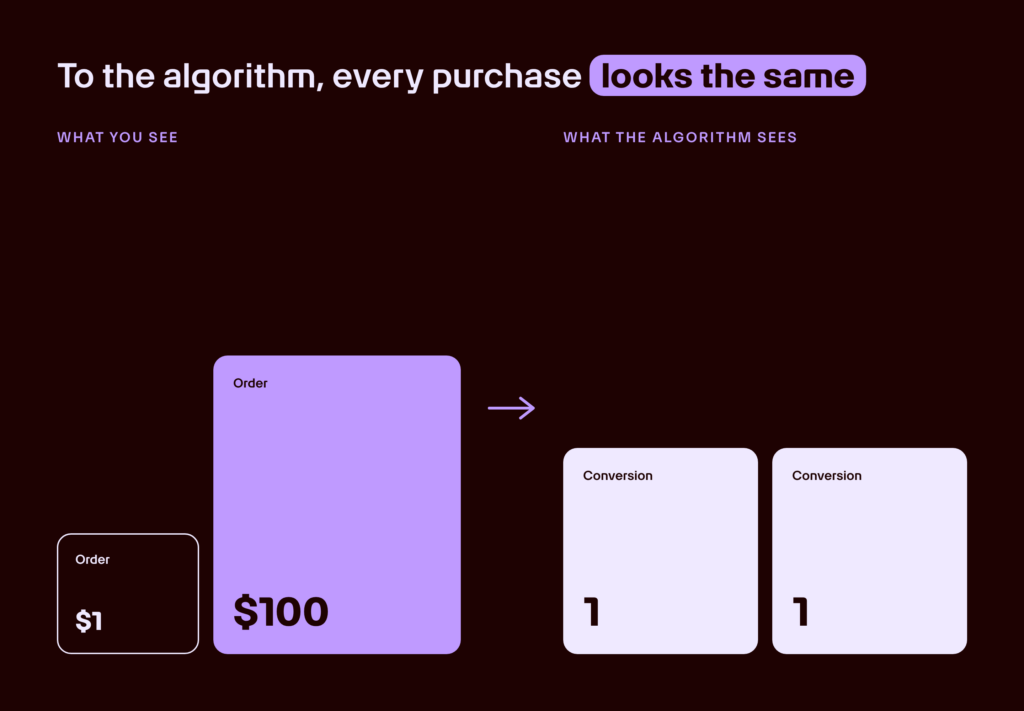
The algorithm looks at who converted, and goes looking for more people just like them. What it learns from is your conversion signal: what you count as a conversion, and the value your tracking registers with it. Say you optimise for purchases. To the algorithm, a $1 order and a $100 order look exactly the same. Guess which one is easier to get?
From equal purchases to real value
A purchase as your conversion goal is a good start. But the signal could be better. Think of it as three steps:
- Every purchase is treated the same. The algorithm only sees volume, so the small, easy orders win. Google: Maximize Conversions or Target CPA. Meta: Maximize number of conversions.
- Purchases with actual value. Your tracking reports the order value without taxes and shipping, minus returns. Now it optimises for dollars, not volume of orders. Google: Maximize Conversion Value or Target ROAS. Meta: Maximize value of conversions.
- Profit and lifetime value. Your tracking reports margin instead of revenue, and gives new customers more weight. Now it goes after profitable growth. Same strategy as step two. Only the number changes.
So, should everyone switch to Maximize Conversion Value? Not necessarily. If the values are wrong, you’ve just taught the algorithm to chase the wrong leads. First, figure out what your tracking can actually report: just the number of purchases, or purchases with the right value? Then pick the strategy that fits.
What about Target ROAS?
It’s Maximize Conversion Value with a goal attached. A target of 500% means you want $5 back for every $1 you spend. Set it too high, and the algorithm barely spends. Set it too low, and nothing changes.
Here’s how we’d do it:
- Get the number right. Without taxes and shipping, minus returns.
- Start without a target for a few weeks, so the algorithm can learn.
- Work out your break-even ROAS.
- Set the target close to what you already get, then adjust in small steps.
Starting from zero?
No conversions in your account means no answer key. Your job is to build one.
- Report the right value from day one.
- In Google Ads, start with Maximize Conversions. Move to Maximize Conversion Value once you have conversions.
- In Meta, you can optimise for add to cart until you have enough purchases.
- Soft signals are fine as a start. Just don’t stay there for ever.
How to give the algorithm better signals
- One primary conversion, close to real business value.
- The right values: without taxes and shipping, minus returns, ideally margin.
- Your CRM connected, so the algorithm learns what counts as real sales.
- Complete tracking with Consent Mode v2, Enhanced Conversions and server-side tracking.
- No double counting.
Everyone has access to the same algorithms. What sets you apart is the data you feed it. The algorithm does exactly what you ask it, but are you asking for the right thing?
Unite your team with Fyr
Bring your team together and achieve more with seamless collaboration. Try Fyr today and experience a smarter way to work collaboratively.