
Should you be advertising in ChatGPT? For five weeks we ran a small test in the newest ad platform on the market. This isn’t a playbook or a final answer, it’s an honest look at what happened, what surprised us and what we’d do differently next time around. We also had a little chat directly with the source.
So, how does it work?
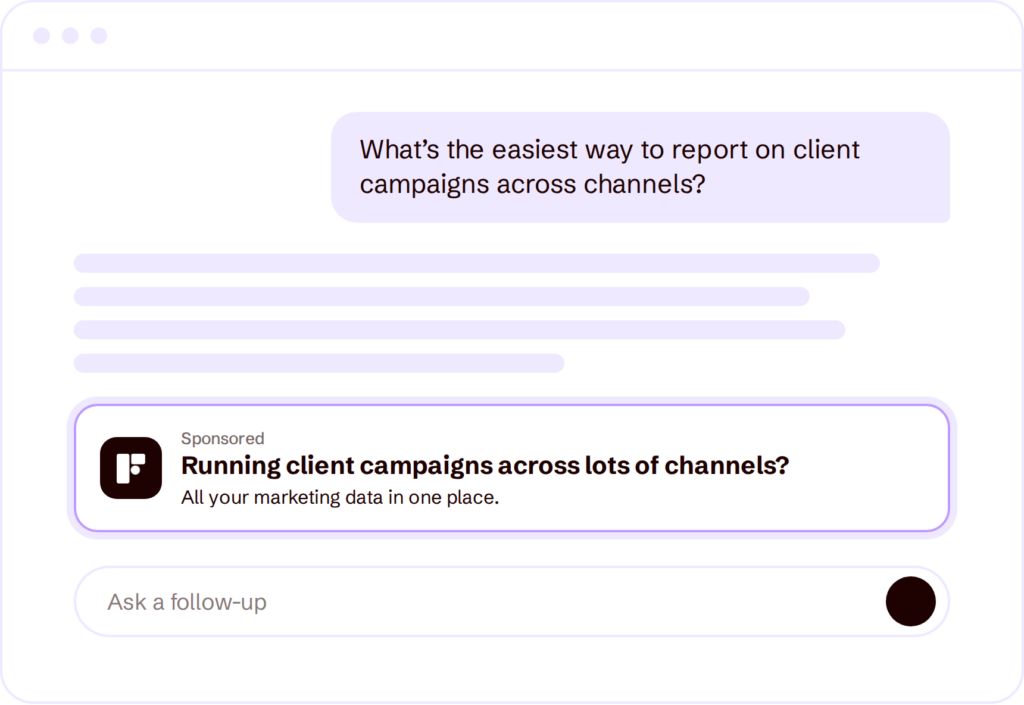
The Ads in ChatGPT show up as sponsored cards below the answer. The ads only appear for people on the Free plan and the cheaper Go plan, so if you are a paying customer you won’t get the ads (yet…)
There are no search keywords like we are used to in Google Ads, but ChatGPT looks at the conversation context and picks what it deems a relevant ad from the ones advertisers have created. According to OpenAI, this won’t affect the answers that ChatGPT gives.
You can pay per click (CPC) or per thousand impressions (CPM), and there’s a pixel and a Conversions API for tracking events on the website.
Our setup
We went live mid September and ran until the end of October, with a daily budget of 15 dollars. Small, yes, but we wanted to learn by running a pretty low risk experiment.
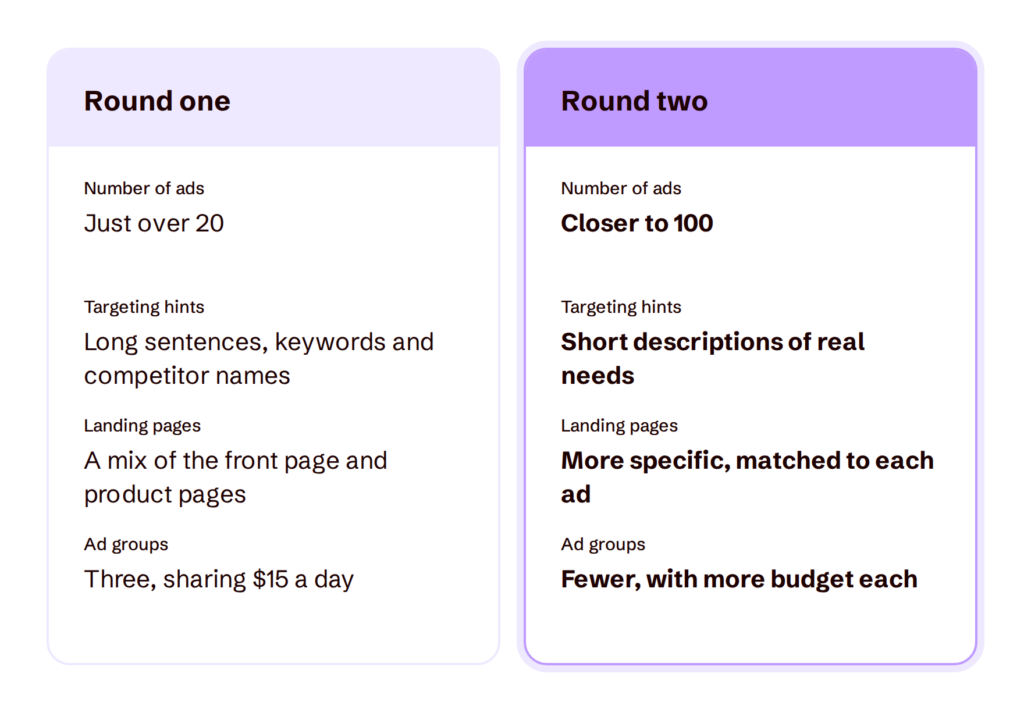
We built three ad groups to test different ways of telling ChatGPT who we wanted to reach:
- Sentence-based: long, natural descriptions of our audience.
- Keywords: short phrases, much like you’d set up keywords in Google Ads.
- Competitors: targeting people who discussed tools like ours.
Our hunch going in? The sentence-based group would win. ChatGPT is built on conversation, so describing the audience in full sentences felt like the natural fit.
The results
Sentences vs keywords vs competitors
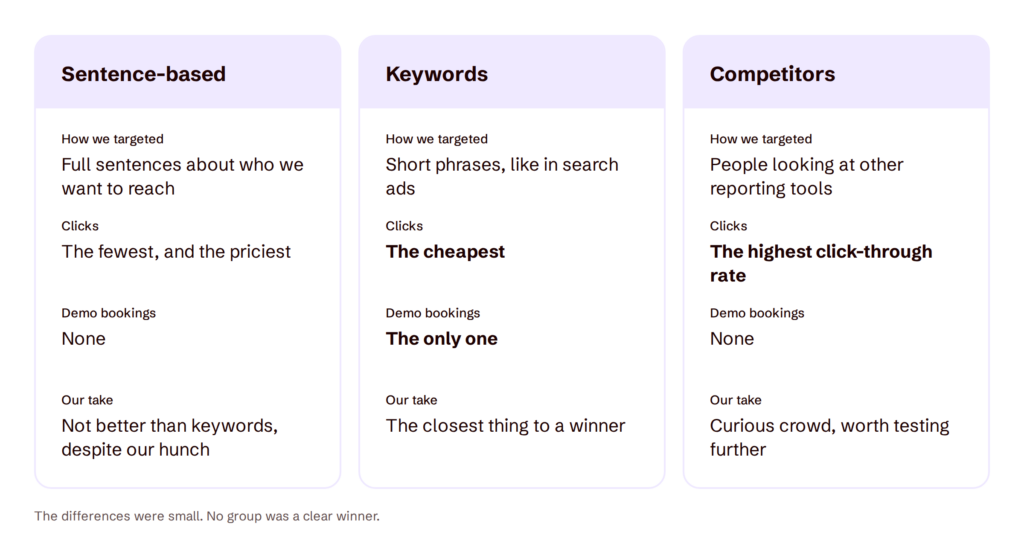
No clear winner. The three groups ended up with pretty similar results, and the long sentence descriptions did not beat plain keywords like we expected.
The competitor group had the highest click-through rate. People who are already thinking about similar marketing tools seem curious about alternatives.
The keyword group had the cheapest clicks and the only conversion. That makes it the closest thing to a winner, but one demo booking is one demo booking.
The sentence-based group came last on both clicks and price. So writing detailed, human descriptions of your audience doesn’t automatically pay off, at least not yet.
Which ads worked?
Let’s talk about the ads. We tested a mix of them. Some about Fyr as a brand, some about specific features and problems, and some simply asking people to book a demo.
What seemed to work best? Ads that opened with a concrete problem our audience might have. They had a cheaper CPC and better delivery than the rest. People come to ChatGPT with a question, so an ad that meets them right there feels more natural. Makes sense, huh?
The general brand messages struggled. And small design tweaks, like a light or dark background, made no noticeable difference, at least not for us.
So, is ChatGPT advertising worth it? Too early to say. But a few things stood out:
- Lead with the problem. Ads that start with something your audience struggles with, fit the conversation best.
- Keywords still hold up. Long sentence descriptions didn’t outperform simple keywords, at least not in our test.
- Competitor targeting gets attention. It had the best CTR, so it’s worth testing further with a landing page that is tailored to the query.
What Open AI recommends
We also had a chat directly with the source itself. Open AI recommends launching with at least 100 ads, so the system has enough variety to match the many ways people ask about the same need (They of course recommended using ChatGPT to write all of these).
Leaning only on brand or competitor names is discouraged, and so is sending everyone to the front page.
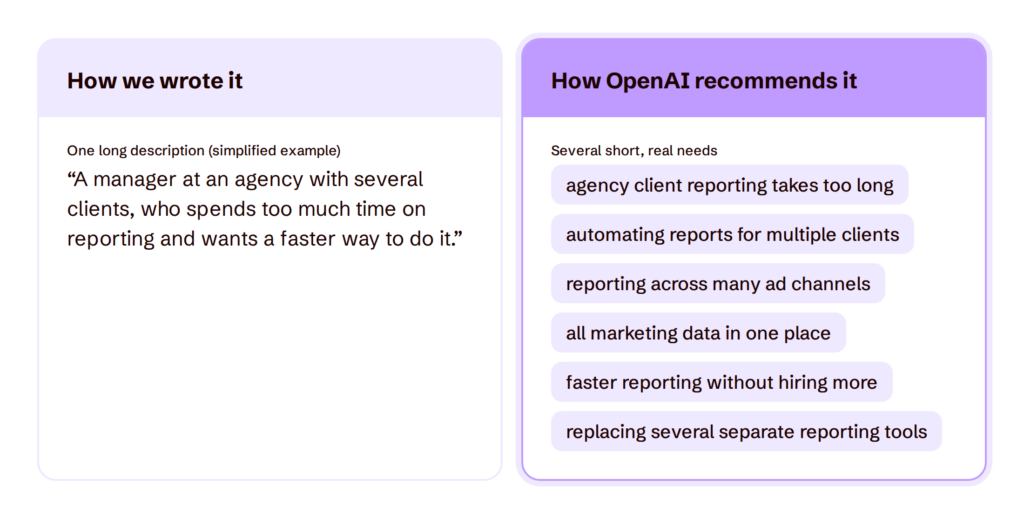
Targeting hints should describe real needs in short, natural phrases of four to five words, which lands somewhere between our sentence-based and keyword groups.
What we’ll do next
Round two is already taking shape. We want to dig deeper into problem-first ads and see which problems actually hit home. This time we’ll follow OpenAI’s advice and launch with far more ads, with context hints written as short descriptions of real needs.
Every ad will link to the pages that fit best, not just the front page. We’ll try softer asks than the very direct “book a demo”, and we’ll run fewer ad groups so each one gets more budget.